
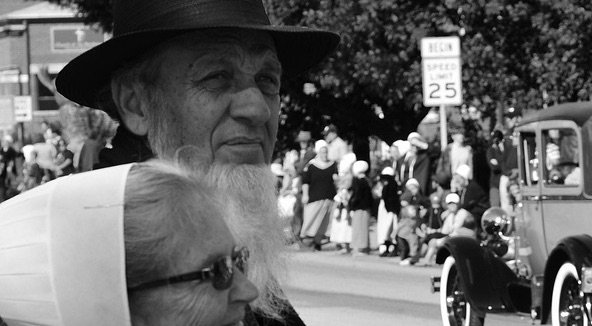
For many outsiders, the Amish beard is instantly recognizable — a frame of thick hair circling the face, often without a mustache. But for Amish men, it is far more than a look. It’s a quiet confession of faith, a lifelong commitment, and a symbol of humility before God.
In a world where appearance is often about self-expression, the Amish beard stands for the opposite — self-restraint, devotion, and belonging. Each strand carries meaning: a mark of adulthood, a sign of marriage, and a reflection of spiritual obedience.
This is the story of how the beard became one of the most enduring symbols of the Amish look — and why it continues to matter in a changing world.
Source: BBC – Inside Amish Communities
A Look Back: The Faith Behind the Beard
To understand the Amish beard, we need to travel back several centuries — to the Anabaptist movement of the 1500s. Early Anabaptists believed in adult baptism, simple living, and separation from worldly vanity. They faced fierce persecution for defying both church and state.
When Jakob Ammann led his followers — now known as the Amish — in the late 1600s, his focus was clear: humility, obedience, and community over individuality. For Amish men, the beard became a symbol of that very humility.
It represented their break from the world — a visible testimony that their identity came not from society, but from God.
As Menno Simons, another Anabaptist leader, once wrote:
“True faith cannot lie dormant; it clothes the naked, it feeds the hungry, it comforts the sorrowful, it binds up that which is wounded.”
In the same spirit, the Amish beard became an outward expression of an inner faith — quiet but steadfast.
Source: PBS – Amish in America
The Moment of Change: Why Amish Men Grow Beards but Not Mustaches
Among the Amish, beards begin with a milestone — marriage.
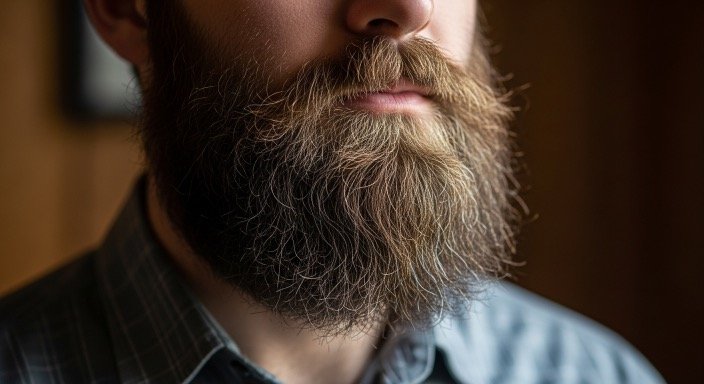
When an Amish man weds, he stops shaving. The growing beard becomes a living symbol of his new role as husband, provider, and spiritual leader in his family.
But what about the missing mustache? That, too, carries meaning. In the 18th and 19th centuries, mustaches were associated with European military officers. To the peace-loving Amish — committed to nonviolence and humility — the mustache became a reminder of pride and aggression.
So they let it go. The beard remained, but the upper lip stayed bare — a quiet protest against vanity and violence alike.
Symbolism and Spiritual Meaning
Every Amish beard tells a story. It’s not simply facial hair — it’s faith made visible.
| Symbolic Meaning | Description |
| Marriage & Maturity | Marks a man’s transition into married life and leadership within his family. |
| Humility | Reflects modesty and obedience to God’s order. |
| Peace & Simplicity | Rejects militaristic mustaches and worldly fashion. |
| Belonging | Connects men visibly to their community and shared values. |
| Faith in Action | A daily reminder that devotion is lived, not spoken. |
The beard says, “I belong to something larger than myself.”
Read also: Amish Men Through Generations — Preserving Faith in a Modern World)
The Practical Side of Simplicity
Amish beard
Amish beard
Like Amish clothing or buggies, the beard has a practical beauty. It requires no styling, no razors, no products — just nature and care.
To the Amish, the idea of “plain” doesn’t mean careless. It means purposeful. The beard becomes part of their daily rhythm, as natural as prayer or milking cows at sunrise.
Even grooming follows communal guidelines. Beards are kept neat and trimmed around the jaw, though never shaped for vanity.
Different Orders, Different Styles
Not every Amish community looks exactly the same. Variations in the beard reflect different Amish orders (levels of conservatism) and local customs.
| Amish Group | Beard Practice | Notes |
| Old Order Amish | Full beard after marriage; no mustache ever | Strict adherence; symbolic of faith and maturity |
| New Order Amish | Same rule, but may allow light trimming | Slightly more lenient communities |
| Beachy Amish / Mennonite Influence | Beards optional; more modern grooming | Reflect engagement with broader society |
These differences remind us that Amish life is not static. It adapts carefully within the boundaries of faith. Each decision — even about facial hair — is communal, prayed over, and rooted in purpose.
Biblical Inspiration and the Meaning of the Beard
The beard isn’t only cultural — it has biblical echoes. In the Old Testament, beards were often associated with wisdom, maturity, and divine calling. Leviticus 19:27 warns against shaving the edges of the beard, a verse some Anabaptists interpreted as promoting natural dignity and respect for God’s creation.
While the Amish don’t treat this as strict doctrine, they see it as harmonious with their values — living simply and accepting oneself as created by God.
A clean-shaven face, by contrast, can symbolize worldliness or vanity. The beard, then, becomes a visible boundary — marking a life lived apart from worldly ambition.
Faith Over Fashion
Amish beard
Amish beard
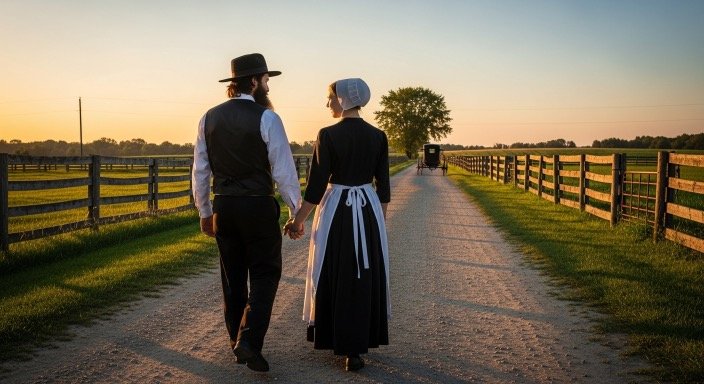
Modern society often treats appearance as self-expression. The Amish beard reverses that logic entirely: it expresses self-denial.
It’s a personal act of devotion that quietly resists the world’s obsession with trends. The beard is neither stylish nor neglected — it is simply honest.
In that way, it mirrors the Amish soul: calm, deliberate, grounded in purpose.
Also read: Amish Clothing — The Meaning Behind Their Simple Style
Beard as Identity and Belonging
Among the Amish, the beard does more than identify a married man — it also identifies belonging.
When you meet an Amish community, you’ll see older men with long, full beards — respected elders whose faces tell stories of faith and endurance. Younger, unmarried men remain clean-shaven, visually distinct until they enter marriage.
This creates an instant visual language of community. Without words, you can read one’s stage of life, commitment, and devotion.
The beard is not private expression — it’s communal confession.
The Social Side: Respect and Discipline
In Amish life, conformity isn’t about control — it’s about unity. When everyone lives by the same visible values, there’s peace and equality.
Amish men do not compete over looks; they compete over integrity. Their appearance says, “We are the same before God.”
The beard keeps that truth tangible. It blurs the line between individual and collective identity, reminding each man that his life contributes to a shared witness of faith.
Modern Influence: When the World Meets the Beard
Even the Amish, though resistant to modern fashion, live near a changing world. Some younger men who work with non-Amish employers or customers must balance traditional appearance with practicality.
Yet even when practical adjustments occur — lighter trimming, safety allowances in factories — the symbolism remains untouched.
The beard endures, not as decoration, but as devotion.
Lessons from the Amish Beard
For those outside the community, the Amish beard can feel foreign — even mysterious. But its lessons are universal:
- Identity can be rooted in humility, not image.
- Faith can be seen in the everyday, not just in words.
- Tradition can thrive when it reflects purpose.
- Simplicity is not weakness — it is strength that doesn’t need attention.
Discover: What Keeps Amish Communities Self-Sufficient in a Fast-Changing World
Key Takeaways
- The Amish beard began as a symbol of humility and continues as a living act of faith.
- It marks marriage, maturity, and community belonging.
- Its absence of a mustache reflects peace and non-violence.
- Across centuries, it remains unchanged — a quiet protest against vanity and pride.
- Its message to the modern world: simplicity can still carry beauty and meaning.
Bringing It All Together: Faith Worn on the Face
In a society obsessed with reinvention, the Amish beard reminds us of constancy. It’s a visible covenant — a living statement that some truths don’t change with time.
Every morning, when an Amish man looks in the mirror, his reflection carries centuries of faith. His beard is not just hair — it’s history, belief, and love woven together.
As he steps out to the fields or workshop, his face tells a story the world too easily forgets: humility never goes out of style.