
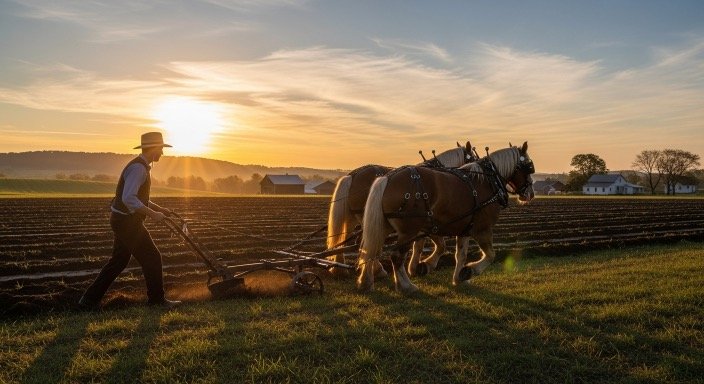
While modern life races forward with screens, social media, and endless noise, Amish men continue to live by rhythms that haven’t changed in centuries. Their days begin before dawn — milking cows, tending fields, or crafting furniture by hand. Their nights end with family prayers, candlelight, and gratitude.
To outsiders, this simplicity might look old-fashioned. But to Amish men, it’s a living statement of faith — proof that peace and purpose don’t depend on modern progress.
This post explores how Amish men have preserved their faith, work ethic, and family values across generations — and what their quiet example teaches us in a world that’s forgotten how to slow down.
Source: Pennsylvania Center of the Book
Faith as the Foundation of Amish Manhood
At the heart of Amish life is faith — not as a belief alone, but as a full way of living. For Amish men, religion isn’t practiced once a week; it’s woven into every action.
Their guiding principle, Gelassenheit — meaning surrender or submission to God’s will — shapes their entire worldview. It calls for humility, obedience, and peace over pride or competition.
Each Amish man takes this to heart, striving to live quietly, serve others, and honor God through honest labor. Success isn’t measured by wealth or titles — it’s measured by faithfulness.
Source: Got Questions
Read also: Amish Women: The Heart of Faith, Family, and Simple Living
The Role of Amish Men: Providers and Protectors
In Amish culture, men carry the responsibility of providing and protecting their families. But unlike in the modern sense of power, this leadership is rooted in service.
Amish men work not for personal ambition, but for community stability. Whether they’re farmers, carpenters, or shop owners, their work serves their neighbors as much as their families.
Common occupations include:
Amish Men
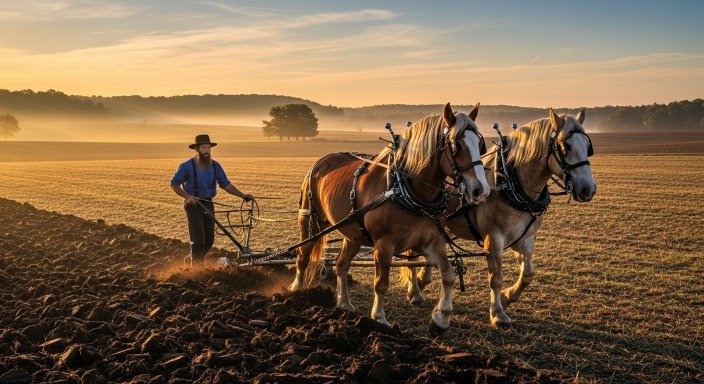
- Farming and animal husbandry
- Carpentry and furniture-making
- Blacksmithing and tool repair
- Operating small construction businesses
- Driving horses and maintaining buggies
Every task is viewed as a calling, not just a job. Work is a form of worship — a way to honor God through craftsmanship and consistency.
Humility Over Status
Amish men live without the modern symbols of success — no flashy cars, no social media, no corporate titles. Instead, humility is their highest honor.
The plain clothing, the simple haircut, and the beard after marriage all carry meaning. The beard signifies maturity and faithfulness, while simple attire symbolizes modesty and equality.
For Amish men, leadership means example — not control. They lead by doing, not by demanding.
Source : The University of Akron – Amish Modesty and Identity.
Family: The Center of Every Amish Man’s Life
An Amish man’s greatest responsibility — and joy — is his family. He leads morning devotions, teaches children to pray, and works alongside his wife to raise children in faith and discipline.
Families are large, often with six or more children. Each child is taught responsibility early — boys learn farming or woodworking, while girls help with household chores and younger siblings.
Evenings are sacred. After supper, families read Scripture, sing hymns, or sit quietly together — a striking contrast to the digital distractions of modern life.
Source: National Endowment for the Humanity – Amish life
Explore: How Amish Communities Stay Self-Sufficient: Everything You Need to Know
Mentorship and Teaching the Next Generation
Amish fathers are teachers by example. They don’t lecture — they demonstrate.
Sons learn trades not through formal classes but by shadowing their fathers. Whether it’s carpentry, farming, or horse care, children absorb values through work.
This generational apprenticeship keeps skills and faith alive. It’s how Amish men preserve their way of life — not by resisting the world, but by raising a new generation who understands why simplicity matters.
Source: Tracy fredrychowski – Amish Work and Apprenticeship
The Beard: More Than a Tradition
Amish men grow beards after marriage, not for fashion but for faith. The beard symbolizes adulthood, humility, and separation from the world’s vanity.
Interestingly, Amish men do not grow mustaches because, historically, mustaches were associated with European military officers. Since the Amish are pacifists, this distinction reinforces their commitment to peace.
Each beard is a quiet badge of faith — a visible reminder of promises kept.
Source: Mindy Steele – Amish Beard
Work Ethic: The Cornerstone of Amish Identity
Amish Men

Amish Men
For Amish men, work is both physical and spiritual discipline. Whether it’s building a barn, shoeing a horse, or crafting fine furniture, every action is guided by honesty and patience.
A famous Amish saying captures it perfectly:
“Hands to work, hearts to God.”
This ethic produces exceptional craftsmanship — Amish furniture, for instance, is renowned worldwide for its quality. But more importantly, this labor brings contentment, not burnout.
Source: Amish America – Amish Work Ethic
Community Service and Brotherhood
Amish men see their neighbors as extensions of their family. When someone falls ill or a barn burns down, men from nearby districts arrive within hours to help rebuild.
The barn-raising tradition is the most visible example of Amish brotherhood — dozens of men working side by side, constructing an entire barn in a single day.
They don’t expect payment. Their reward is fellowship and faith in action.
Source: Philosophical Rambler. – Amish Mutual Aid Networks
Leadership in the Church
While Amish women are spiritual anchors at home, men serve formal leadership roles in the church. Ministers, deacons, and bishops are chosen by lot — a process believed to reflect God’s will, not ambition.
These leaders guide worship, oversee church discipline, and maintain harmony in the community. Yet, even leaders maintain humility — no salary, no hierarchy, no praise. Leadership is service, not status.
Source: Amish America – Worship and Leadership
Resisting Modern Pressures
The modern world often views progress as convenience, but Amish men view it as temptation. Smartphones, cars, and electricity are seen as distractions that could weaken community bonds.
Their refusal isn’t ignorance — it’s intentional. Each Amish district collectively decides which technologies align with their values. Some allow solar power or pneumatic tools; others do not.
The goal is control: to use technology when it serves faith, not when it controls it.
Source: Groups Etown – Amish and Technology
Adaptation Without Compromise
Though resistant to change, Amish men are not frozen in time. They adapt quietly when it preserves faith. For instance, some run small businesses using off-grid tools or collaborate with non-Amish workers through handwritten contracts.
Younger Amish men today might work in construction firms or manufacturing, balancing old-world discipline with modern opportunities.
But the boundaries remain firm — no debt, no greed, and no compromise on moral values.
Source: American Studies Journal – Amish Adapting to Modern Economies
The Next Generation of Amish Men
Every generation faces a choice: stay or leave. Some young Amish men experience Rumspringa — a period of exploration before baptism.
While a few leave permanently, the vast majority return. They find the modern world noisy, disconnected, and spiritually hollow.
Returning home, they commit fully to their community — embracing simplicity over chaos. It’s not blind obedience; it’s conscious conviction.
Source: Ohio’s Amish Country – Rumspringa and Amish Youth
Lessons from Amish Men
The example of Amish men holds timeless wisdom for modern life:
- Work with purpose, not pressure.
- Lead through service, not authority.
- Value peace over possessions.
- Guard faith as your truest inheritance.
In a society obsessed with speed and self-promotion, Amish men remind us that quiet strength and moral consistency are far more enduring.
Discover: What Keeps Amish Communities Self-Sufficient in a Fast-Changing World
Final Thoughts: Faith That Outlasts Time
Across generations, Amish men have stood as pillars of faith and perseverance. They live proof that modernity isn’t the only path forward — sometimes, staying rooted is the strongest form of progress.
Their barns may be built by hand, their prayers whispered in candlelight, but their legacy shines far beyond their fields. In every generation, their faith survives — not through isolation, but through dedication.
And in a world rushing toward the next big thing, their lives whisper a powerful truth: the old ways still have something sacred to teach us.
Source: WSJ – Faith and Family Among Amish Men