
Amish butter
Walk into any Amish market on a crisp morning, and you’ll notice something different about the butter sitting on the wooden shelves.
It’s not wrapped in fancy foil or labeled with bright colors. It sits quietly — pale gold, hand-shaped, and fragrant with the sweetness of real cream.
That’s Amish butter — a simple food that somehow feels like home the moment you see it.
While most modern butter is made in factories by machines, Amish butter is born from faithful labor, old-fashioned patience, and a belief that quality is a kind of worship.
It’s richer.
It’s creamier.
And it carries a story that begins long before it reaches your table.
Today, we’ll uncover the secrets behind what makes Amish butter so special — and what this old-world tradition can teach us about slowing down and savoring life.
Read our article: Amish Women: The Heart of Faith, Family, and Simple Living)
The Secret Starts With the Milk — Fresh, Local, and Pure
Most Amish butter begins at sunrise, when cows are milked by hand in quiet barns warmed by the breath of early morning.
There’s no hum of electric machines — only the soft rhythm of milking, the steady sound of pails filling, and the gentle gratitude of a day beginning.
Amish farmers know their cows by name. They treat them with respect, believing that care reflects stewardship of God’s creation. Healthy cows, fed on grass and fresh hay, produce milk rich in flavor and nutrients.
That milk is the foundation of everything that follows — untouched by industrial shortcuts, unhurried by schedules, and unspoiled by overprocessing.
Lomilis Market notes that Amish farmers rely on natural methods to maintain milk supply, focusing on proper nutrition and care.
The Churning — Slow Hands, Strong Faith
If modern butter production is about efficiency, Amish butter making is about intention.
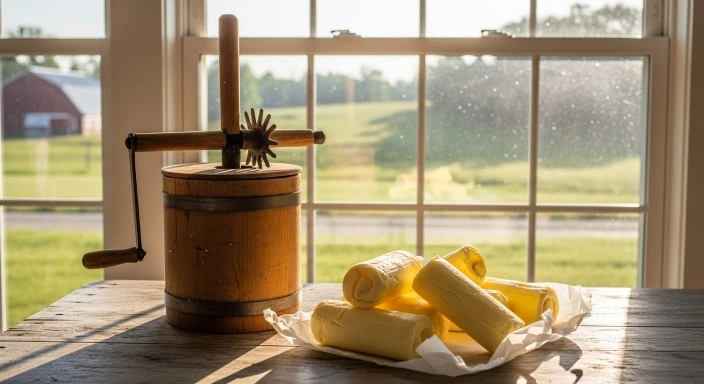
Once the cream has risen naturally to the top of the milk, it’s skimmed off and placed into a hand-churn — often a wooden or metal barrel turned by hand or by a simple mechanical crank.
As the cream thickens, the rhythm of the churning becomes a quiet act of meditation. The Amish see work not as labor, but as service.
Each turn of the churn is accompanied by patience — the kind of patience only those who live close to nature truly understand.
It’s not about speed; it’s about faith in the process.
And when the cream finally transforms into butter, there’s a collective peace in the room. The work becomes worship — a blend of gratitude and grace.
More information on: Spiritual Practices of the Amish People: Prayer, Church, and Silence)
The Flavor Difference — Rich, Creamy, and Honest
When people first taste Amish butter, they often say it feels alive.
That’s because Amish butter has a higher butterfat content — usually around 84 percent, compared to 80 percent in standard store brands. This gives it a silkier texture and a fuller, creamier flavor.
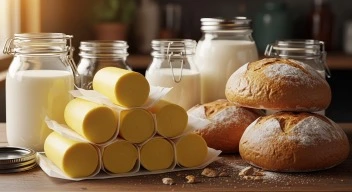
It spreads smoothly over warm bread, melts beautifully into vegetables, and carries the deep sweetness of fresh cream. There’s no artificial color, no stabilizers, and no preservatives. Just milk, salt, and time.
“It tastes like butter used to taste,” one visitor to an Amish market once said.
And it’s true — every bite feels like a return to something honest.
Handmade, Not Machine-Made — A Tradition That Honors Simplicity
In an Amish kitchen, tools are minimal, but hearts are full.
There’s no industrial mixer or electric thermometer. The butter maker relies on touch, sight, and experience — skills passed down from mother to daughter, from neighbor to neighbor.
Temperature is judged by feel.
Cream readiness is known by sight.
And quality is measured by care, not calibration.
Each batch is small, consistent, and personal. The process preserves not only flavor but a sense of responsibility — to the land, to the animal, and to the faith that guides their every motion.
Community and Butter-Making Go Hand in Hand
Amish butter

Amish butter
Amish butter isn’t just food — it’s fellowship.
Churning days are often family affairs. Children learn by watching. Elders guide with patience. The kitchen fills with laughter, stories, and the warmth of shared purpose.
After the butter is ready, the buttermilk left behind becomes pancakes, biscuits, or even soap — nothing wasted, everything used.
This circular, humble way of life teaches sustainability long before the word became trendy.
Read our article: What Keeps Amish Communities Self-Sufficient in a Fast-Changing World)
From Cream to Table — No Waste, No Rush
Once the butter has formed, it’s washed carefully to remove remaining buttermilk — a step that gives Amish butter its long shelf life and clean flavor.
It’s then pressed, shaped, and wrapped in parchment or wax paper, often by hand. Each roll feels personal — no two look exactly the same.
The Amish way reminds us: imperfection can be beautiful.
Even this simple food carries the lesson that speed, uniformity, and packaging are no match for authenticity.
Faith at the Core — Work as Worship
Amish butter
Amish butter
For the Amish, every task — whether plowing a field or churning butter — carries spiritual meaning.
The rhythm of butter-making mirrors their values: patience, humility, gratitude, and service.
They see creation itself as a partnership with God.
The cow gives milk.
The hands shape it into nourishment.
The family gives thanks.
Work becomes prayer in motion.
And every finished roll of butter is, in its quiet way, a hymn of gratitude.
Why the World Still Loves Amish Butter
Despite its small-scale production, Amish butter has found admirers far beyond Lancaster County and Holmes County.
Chefs prize it for its high butterfat content.
Home bakers treasure its flavor.
Visitors buy it as a reminder that food can still tell a story.
And for many, Amish butter represents more than a product — it represents a principle:
Do one thing well, and do it with love.
Lessons from the Butter Churn
When we watch the Amish work, we learn something profound about our own hurried world.
- Patience creates quality.
- Humility sustains faith.
- Gratitude brings joy.
Every simple act, done faithfully, can become sacred.
Even making butter.
Especially making butter.
The Takeaway — The Golden Taste of Gratitude
In a world obsessed with speed and perfection, Amish butter stands quietly apart — a small, golden reminder that beauty is often found in the unhurried, unseen, and unpolished.
It tastes like simplicity.
It feels like gratitude.
It reminds us that when work is done with love, even the most ordinary things — like a pat of butter — can become extraordinary.
So the next time you spread a slice of Amish butter on warm bread, remember:
You’re not just tasting cream.
You’re tasting devotion, patience, and faith turned into flavor.