
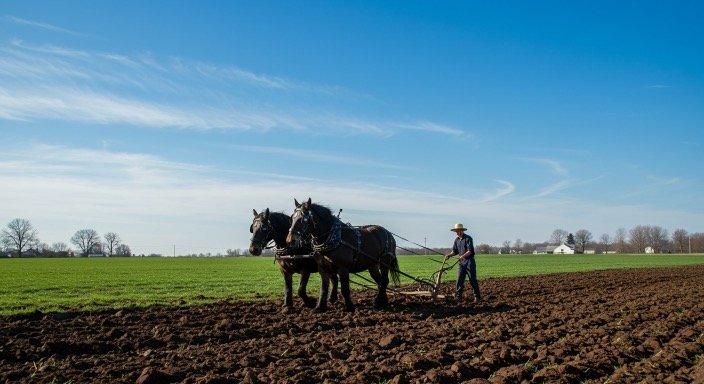
In a world dominated by tractors guided by GPS and fields monitored by drones, the Amish stand as a rare reminder of what farming once meant — a balance between faith, land, and community. While most of us associate modern agriculture with high-tech machinery and chemicals, Amish farming techniques still used today prove that productivity and sustainability can thrive without automation.
These time-tested methods, passed down through generations, show that farming isn’t just about yield — it’s about stewardship. The Amish see the land as a gift from God, not a resource to exploit. Every plow stroke and seed planted reflects gratitude, patience, and harmony with nature.
The Amish Philosophy of Working the Land
The Amish farming philosophy is rooted in faith. They believe that humans are caretakers of the earth — responsible for maintaining its health rather than exhausting it for profit. This belief influences every farming decision they make, from crop choice to equipment design.
While other farmers might rely on synthetic fertilizers or automated irrigation, the Amish depend on organic compost, animal manure, and natural water cycles. They see farming as a partnership with creation — not a battle against it.
Source: National Geographic – Amish Agricultural Traditions
The Power of Horse-Drawn Farming
Amish Farming Techniques Still Used Today
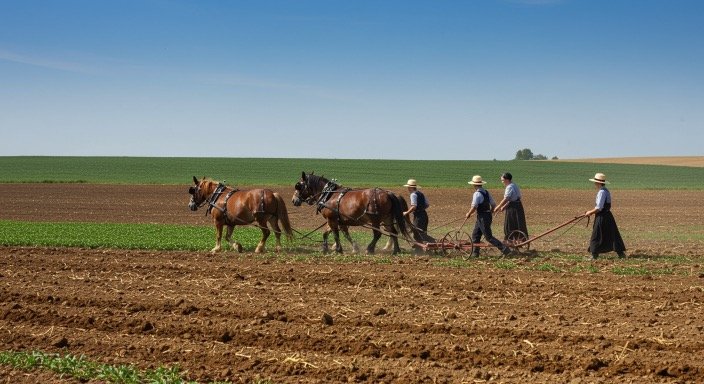
One of the most visible signs of Amish farming tradition is the horse-drawn plow. Many Amish farmers still use teams of horses or mules to till the soil, a method that dates back centuries.
Why stick to horses in an age of diesel-powered tractors? The answer is both practical and spiritual. Horses are reliable, renewable, and keep the pace of farming slow and intentional. They also prevent soil compaction — a common problem with heavy machinery that damages the earth’s structure.
In short, horse-drawn plowing represents the Amish respect for the land’s natural rhythm — a hands-on relationship that values endurance over speed.
Source: Amish America – Horse Power on Amish Farms
Amish Farming Techniques Still Used Today
Crop Rotation: The Original Soil Science
Modern farmers rely on chemical fertilizers to restore nutrients to overworked soil. The Amish, however, continue to practice crop rotation, one of the oldest and most effective soil management techniques.
By alternating crops like corn, alfalfa, soybeans, and wheat, Amish farmers maintain soil fertility naturally. Legumes such as alfalfa or clover fix nitrogen into the soil, reducing the need for artificial inputs.
This simple yet powerful system ensures long-term sustainability — keeping the land productive for future generations without damaging the ecosystem.
Organic Soil Enrichment: Compost, Not Chemicals
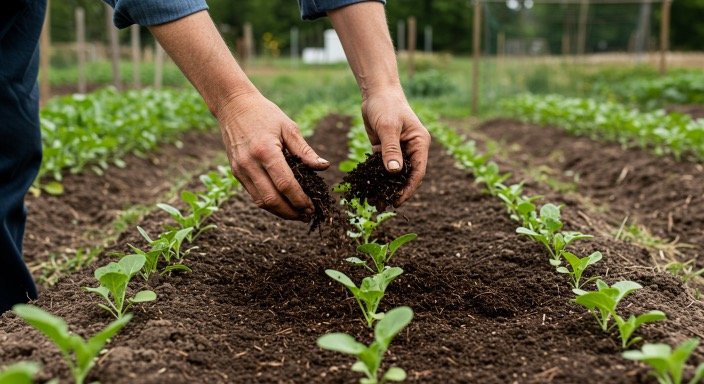
Instead of synthetic fertilizers, Amish farmers rely on organic matter to nourish their fields. Animal manure, composted crops, and kitchen waste become valuable fertilizer. This approach not only enhances soil quality but also promotes biodiversity in the ground.
Composting is an art form in Amish communities. Layers of straw, manure, and vegetable matter are carefully turned and aged, creating nutrient-rich humus that keeps crops strong and resilient.
In essence, every farm is a closed-loop system — nothing goes to waste, and everything that comes from the land eventually returns to it.
Source: Rodale Institute – Organic Farming Systems
Amish Farming Techniques Still Used Today
Hand Harvesting and Human Labor
In most modern farms, machines roar through fields during harvest season. On an Amish farm, the process is far quieter — and more deliberate. Many crops are still harvested by hand or with horse-drawn reapers, especially in smaller communities.
This technique ensures minimal waste and careful handling. More importantly, it strengthens community bonds. Harvest time often becomes a social event — families and neighbors helping one another to bring in the crops.
The Amish believe that hard work done together honors both God and the land.
Source: Modern Farmer – Manual Farming Practices
Natural Pest Control: Balance Over Chemicals
Rather than spraying pesticides, Amish farmers rely on natural pest control techniques. This includes crop diversity, companion planting, and introducing predator species like birds or beneficial insects to control pests naturally.
For example, planting marigolds or garlic among vegetable rows deters harmful insects, while encouraging ladybugs and praying mantises helps manage aphids and beetles.
This eco-friendly approach keeps food chemical-free and aligns perfectly with Amish values of stewardship and respect for creation.
Amish Farming Techniques Still Used Today
Manual Irrigation and Water Conservation
Water is another area where Amish farmers blend tradition with wisdom. Without electric-powered pumps, they often use gravity-fed irrigation systems, rainwater collection barrels, and natural streams.
In drier months, watering is done manually using buckets or simple hand pumps. It’s labor-intensive, but it prevents overuse of water resources and teaches responsibility — something many modern farms overlook.
Amish farmers see irrigation not as an industrial process but as a sacred duty to sustain life without greed.
Source: Penn State Extension – Amish Water Use Practices
Amish Farming Techniques Still Used Today
Seed Preservation and Heirloom Varieties
While the commercial seed industry dominates global agriculture, many Amish farmers continue to save and plant heirloom seeds. These seeds are collected from their own harvests each year, preserving genetic diversity and regional adaptation.
Heirloom crops produce better flavor and are naturally resistant to local pests and diseases — no need for chemical enhancements. This tradition safeguards food heritage and keeps farming personal, not corporate.
Source: Seed Savers Exchange – Heirloom Farming
Amish Farming Techniques Still Used Today
Mixed Farming and Crop-Livestock Integration
Amish farms are rarely monocultures. Instead, they practice mixed farming, combining crops, livestock, and orchards in one ecosystem. Manure from animals feeds crops, crop residues feed livestock, and trees provide shade and wind protection.
This circular relationship mimics nature itself, creating a balanced, self-sustaining system. It’s one of the clearest examples of how Amish farming techniques still used today promote long-term ecological harmony.
Source: SARE – Sustainable Mixed Farming Systems
Amish Dairy and Livestock Care
Amish farmers are known for producing high-quality dairy, eggs, and meat without relying on industrial feedlots or antibiotics. Cows graze freely on open pastures, chickens roam outside, and pigs are raised in humane environments.
This slow, natural approach ensures animal welfare while producing nutrient-dense food. Their respect for animals reflects their larger philosophy — everything that lives has a purpose, and nothing should be wasted or abused.
Tools of Simplicity: Farming Without Electricity
Most Amish farms operate off the grid, meaning no electricity from public utilities. Instead, they use hand tools, horse-powered machinery, and sometimes pneumatic (air-powered) systems.
You might find hay balers or milkers powered by compressed air, or barns lit by gas lamps. This limited use of energy ensures that technology remains a servant, not a master — keeping farming humble and intentional.
Source: Amish America – Technology on Amish Farms
The Role of Family and Community
Perhaps the most enduring “technique” of all isn’t mechanical — it’s social. Amish farming thrives because it’s family-centered. Every member, from children to grandparents, contributes.
Planting, weeding, harvesting, and caring for animals become shared experiences that reinforce bonds and teach discipline. Work isn’t viewed as a burden but as a form of worship.
Environmental Benefits of Amish Farming
The results of these methods are striking. Amish farms often have richer soil, healthier livestock, and greater biodiversity than industrial farms. Because they avoid synthetic inputs, their fields act as carbon sinks — storing rather than releasing greenhouse gases.
Their small-scale, low-impact approach also supports sustainable local economies. Food is sold within nearby towns, reducing transportation emissions and keeping wealth inside the community.
Source: Yale Environment 360 – Sustainable Agriculture Lessons
What We Can Learn from Amish Farmers
In an era where modern agriculture faces challenges like soil depletion and climate change, Amish farming techniques still used today offer timeless lessons:
- Simplicity can be sustainable. You don’t need high-tech tools to care for the earth.
- Balance matters. Farming should feed both people and the planet.
- Community builds resilience. Cooperation sustains more than machinery ever could.
Even for non-Amish farmers, integrating elements like composting, crop rotation, or heirloom seeds can make agriculture more ethical and enduring.
Source: Intentional Community – Lessons from Amish Sustainability
Final Thought: The Future in Their Past
The Amish may seem old-fashioned, but their techniques are remarkably modern in purpose. Their farms operate without noise, chemicals, or pollution — yet produce abundance through wisdom, patience, and faith.
As society seeks answers to the environmental crises caused by industrial agriculture, the Amish quietly demonstrate that progress doesn’t always mean innovation. Sometimes, it means preservation.
In their fields, the past and future meet — proving that when you honor the land, it will always honor you back.
Source: Amish Heritage – Amish Farming Insights
Explore more articles about Amish lifestyle here