
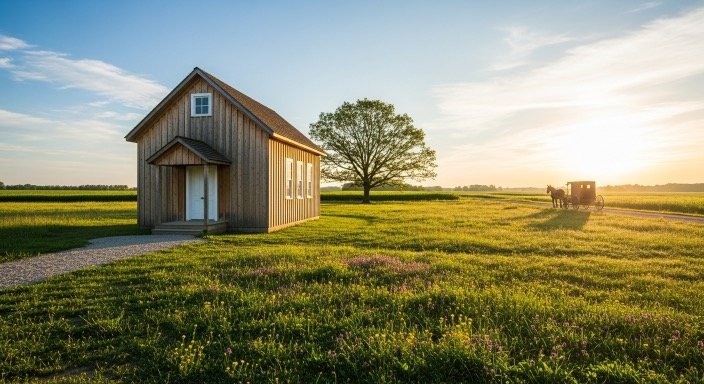
Amish schools
Step through the wooden door of an Amish schoolhouse, and you’ll hear something rare: the sound of pencils scratching, the rustle of books, and the gentle hum of children reciting lessons together. No computers. No fluorescent screens. No digital clocks ticking away the day. Just learning — simple, focused, and full of purpose.
Amish schools remind us that education doesn’t need to be loud to be effective. Here, children learn through humility, repetition, and responsibility — shaped as much by faith as by academics.
As one Amish father once told a researcher for Amish America, “We want our children to learn what they need to live well — not what they need to live proud.” That single sentence captures what makes these classrooms so different — and so quietly beautiful.
The Roots of Amish Education
The Amish commitment to simplicity extends beyond dress and technology — it reaches deep into how they teach their children.
A Faith-Driven Beginning
Amish schooling began in the 18th century, as families arriving from Europe sought to preserve their Christian identity while raising children who could read Scripture and work the land. For centuries, faith and practicality have remained the twin pillars of Amish education.
Their schools were built not for prestige, but for purpose — to pass down humility, obedience, and the skills needed for everyday life. The first formal Amish schools appeared in Pennsylvania and Ohio, small wooden buildings with one teacher guiding students from grade one through eight.
Source: PBS – Amish in America)
Inside a One-Room Schoolhouse
A typical Amish school is modest: white siding, green shutters, a small playground with a swing set, and maybe a horse-shed beside it. Inside, a coal stove warms the room in winter, and sunlight pours through simple windows.
There are no loudspeakers or projectors — just blackboards, chalk, and Bibles.
Children sit in neat rows, with older students sometimes helping the younger ones. Desks are wooden, floors are swept daily, and walls are often decorated with Scripture verses or hand-drawn maps.
When the morning bell rings, all bow their heads for prayer. That moment — a stillness shared by every child — reflects what Amish education is built upon: humility, gratitude, and togetherness.
Read also: What Keeps Amish Communities Self-Sufficient in a Fast-Changing World)
Curriculum: Learning for Life, Not for Status
Amish children typically attend school until eighth grade — and that’s by choice, not neglect. Their education focuses on what is practical and spiritually grounding.
| Subject | Purpose |
| Reading & Writing | To understand Scripture, communicate, and record work or letters. |
| Arithmetic | To manage household, farm, and business needs accurately. |
| German & English | To preserve cultural heritage and interact with non-Amish neighbors. |
| Geography & History | To appreciate God’s world and human responsibility. |
| Bible Study & Moral Lessons | To live faithfully and serve others. |
Rather than preparing for college, students prepare for community life — work on the farm, running a business, or managing a household.
As Smithsonian Magazine noted, Amish schooling emphasizes “responsibility, cooperation, and faithfulness over competition.” Children don’t chase grades or awards; they learn because learning honors God.
The Teacher’s Role — A Shepherd, Not a Supervisor
Amish schools

Amish schools
Most Amish teachers are young, unmarried women from the community. They’ve completed the same eighth-grade schooling and are chosen for their faith, patience, and example, not their credentials.
They earn modest pay, but they hold great respect. Their authority comes not from a degree, but from character.
An Amish teacher’s day is filled with more than lessons — it’s full of guidance. She comforts shy children, leads hymns, and gently reminds students that humility matters more than intellect.
Her blackboard is a ministry. Her chalk dust is service.
Simplicity That Shapes Character
The absence of technology in Amish schools isn’t rejection for rejection’s sake — it’s protection. The community believes screens and gadgets would distract children from faith and family.
Instead, students learn patience, listening, and reflection. When they solve problems on paper, they build concentration; when they recite aloud, they strengthen memory; when they help younger classmates, they cultivate humility.
It’s education as formation — shaping not just minds, but souls.
Faith at the Core of Learning
Amish schools

Amish schools
Prayer begins and ends each school day. Bible stories are read often, not as doctrine, but as examples of courage and kindness. Children are taught that wisdom comes from God — and that intelligence means little without humility.
One Amish proverb written on many classroom walls reads:
“Better a child learn to serve with a quiet heart than to speak with many words.”
The tone of every lesson reflects that truth.
Also read: Amish Women — The Heart of Faith, Family, and Simple Living
Lunch, Play, and Fellowship
When the lunch bell rings, children gather at long wooden tables, unpacking simple meals: bread, cheese, apples, and homemade pie. There’s laughter, sharing, and grace before eating.
Recess isn’t about phones or social media — it’s tag, jump rope, or baseball on a grassy field. The goal is togetherness, not distraction.
Teachers often join in, modeling joy through simplicity. It’s a rhythm that keeps childhood pure — a kind of peace rare in the modern world.
Learning Beyond Books — Work, Family, and Community
Amish education doesn’t stop at the schoolhouse door. Children learn as much from home as from class.
After school, they help milk cows, bake bread, or mend fences. Each task teaches patience and cooperation — lessons that shape adulthood.
By age sixteen, many leave school for apprenticeships or home responsibilities. But their real education continues: in worship, work, and daily acts of service.
It’s a seamless blending of education and vocation, where both glorify God.
Challenges in a Modern World
The Amish approach to education hasn’t always been accepted. In the 1950s, many U.S. states pushed for mandatory high school attendance. The Amish refused — believing advanced education would pull children from faith.
This conflict reached the U.S. Supreme Court in 1972 with Wisconsin v. Yoder, which ruled in favor of the Amish, protecting their right to limit schooling to eighth grade.
The decision recognized Amish education as both religious freedom and cultural heritage — a landmark that still shapes Amish life today.
Values Passed Through Simplicity
Amish education passes on more than skills — it passes on values:
- Humility: No student is better than another.
- Community: Everyone learns from and helps each other.
- Responsibility: Work is a privilege, not a burden.
- Faith: God’s presence is constant, even in arithmetic.
- Contentment: Enough is a blessing; excess is a distraction.
Each child carries these truths into adulthood, weaving them into farming, family, and business life.
Lessons for the Modern Reader
The Amish school may seem like a relic of another time, yet its wisdom is timeless. In a world where education often chases performance, the Amish model quietly insists that character is the highest achievement.
Their way of teaching offers a countercultural lesson: slow down, simplify, and focus on what truly matters.
You don’t need to reject technology or move to the countryside to learn from them. You only need to ask: What am I teaching my children to love — progress or peace?
Explore: Mennonites vs Amish Now — How Faith Keeps Two Traditions Alive)
Final Thoughts — When Simplicity Becomes Wisdom
As the afternoon sun dips behind the fields, the last school bell rings. Children gather their books, say a closing prayer, and step outside to the rhythm of buggies and bird songs.
They haven’t memorized formulas for wealth or ambition — they’ve learned something deeper: how to live with purpose, gratitude, and community.
In the world’s race for progress, Amish schools remain a quiet sanctuary, teaching that wisdom doesn’t always come from having more — sometimes, it comes from needing less.