

Amish beliefs about community and civic responsibility
When we think about the Amish, we often imagine quiet farms, horse-drawn buggies, and handmade quilts. But behind the beauty of their simplicity lies a deep and thoughtful question:
How does a community that avoids modern conveniences relate to the world around them — especially government and civic life?
For the Amish, the answer is rooted not in politics, but in principle — in a faith-centered worldview where Amish community life and humility guide every choice. Their sense of Amish values shapes how they serve both God and neighbor.
Their daily lives are guided by faith, humility, and a desire to remain separate from worldly influence. That separation extends to nearly every part of life — from technology to education, and even to how they view their civic responsibilities.
Today, we’ll explore how the Amish balance faith, community, and government — and what their quiet example teaches us about integrity and peaceful living.
Read the suggested article: What Keeps Amish Communities Self-Sufficient in a Fast-Changing World
Amish Beliefs About Community and Civic Responsibility — Faith Comes First
The Amish do not separate religion from daily life. Their belief system flows through everything — work, family, education, and community service.
They follow a principle known as “Gelassenheit,” a German word meaning submission or yielding to God’s will.
This concept shapes their relationship with all forms of authority. Their belief in obedience, service, and peace defines not only their personal choices but also their Amish lifestyle as a whole.
When it comes to civic matters, Amish people often ask one question before acting:
“Does this align with our faith and our commitment to humility?”
They believe that serving God through obedience and good works is more meaningful than public recognition or influence.
BBC explains that Amish communities base their moral and civic behavior on Biblical teachings emphasizing peace, honesty, and humility.
Community Before Country — But Never Against It
Amish people see themselves as citizens of both the Kingdom of God and the land they inhabit, but the order matters. Their faith comes first.
They live peacefully within their local and national laws, pay taxes, and respect authority — but they avoid involvement that could compromise their spiritual separation from the modern world. This approach reflects centuries of Amish culture built around cooperation and shared faith. Within this Amish religion, daily life becomes an act of stewardship — where harmony within the community outweighs individual ambition.
For example, while most Amish avoid political campaigning or running for office, they actively engage in community-based responsibility:
- They support their neighbors through hard times.
- They contribute to local needs, like school funding or disaster recovery.
- They work cooperatively with local authorities when needed.
Their loyalty to community over competition makes them strong local citizens, even without seeking power or public attention.
Suggested read: Old Wisdom, New Relevance: Amish Farming Techniques Still Used Today)
The Principle of Peace — Why Amish Avoid Political Division
Amish beliefs about community and civic responsibility

Amish beliefs about community and civic responsibility
One of the most defining values of Amish faith is nonresistance — the belief that peace is always better than power.
This idea, drawn from the teachings of Jesus in the Sermon on the Mount, guides how Amish people interact with government and civic systems. They do not engage in conflict, protest, or public debate.
Instead, they lead by quiet example.
“We believe in living our faith, not arguing it,” one Amish farmer once said.
Their peaceful nature isn’t about disinterest — it’s about discipline. This deep sense of Amish faith teaches that true strength lies in forgiveness, quiet service, and cooperation over conflict. They practice restraint in a world that rewards noise.
Civic Duties Done Differently
Although the Amish do not seek government roles or modern influence, they do respect the structures that allow their communities to live peacefully.
Their form of participation often looks different, yet deeply responsible.
Here’s how civic duty is lived in Amish life:
- Obedience to law: Amish communities follow local, state, and national laws unless they directly conflict with Scripture.
- Paying taxes: Contrary to common myths, Amish families pay property, income, and sales taxes. They only refrain from Social Security contributions because their church provides its own support system for the elderly.
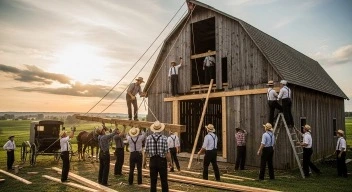
- Service through community: Instead of political engagement, Amish members serve through mutual aid — helping rebuild barns, care for widows, and support those in need.
- Respectful cooperation: They maintain good relationships with local officials, law enforcement, and neighboring communities.
These simple acts, though quiet, create a deep sense of stability and trust.
Faith, Responsibility, and Separation — A Delicate Balance
Amish beliefs about community and civic responsibility
Amish beliefs about community and civic responsibility
The Amish view separation from the modern world as a safeguard for their souls, not a rejection of society. Within that balance, Amish cooperation becomes a spiritual practice — neighbors lifting neighbors, communities thriving through mutual aid rather than competition.
They recognize that every person must live within a government system — but they strive to keep their loyalty anchored in faith, not in human institutions.
This balance allows them to live peacefully alongside others while staying true to their spiritual path.
Their approach teaches a quiet kind of citizenship — one built not on competition or persuasion, but on integrity, honesty, and service.
Quick Insight: Amish community life thrives on faith, humility, and cooperation — timeless values that continue to define their culture today.
What We Can Learn from the Amish View of Responsibility
In a world where civic engagement is often measured by visibility, the Amish remind us that the truest form of service doesn’t always make headlines.
Their quiet way of living offers powerful lessons:
- You can honor the laws of your country without losing your faith.
- True service begins at home, with neighbors and community.
- Integrity doesn’t need attention to be meaningful.
Perhaps that’s what makes their way so remarkable — it reflects a faith strong enough to be still, and a peace deep enough to withstand noise.
Read our article about: Spiritual Practices of the Amish People: Prayer, Church, and Silence
The Bottom Line — Living Faithfully in Both Worlds
The Amish show us that it’s possible to live faithfully within a modern nation without being consumed by it.
Their quiet civic life isn’t disinterest — it’s devotion.
Their separation isn’t rejection — it’s reflection.
And their peace isn’t passive — it’s powerful.
In their barns and fields, in their markets and meetings, the Amish carry the same truth into every act:
“We are in the world, but not of it.”
That simple truth continues to guide them — a reflection of enduring Amish values that still inspire peace in modern life — and it may hold a reminder for us all.You don’t have to be loud to make a difference.
You only have to live what you believe.