
Amish wedding
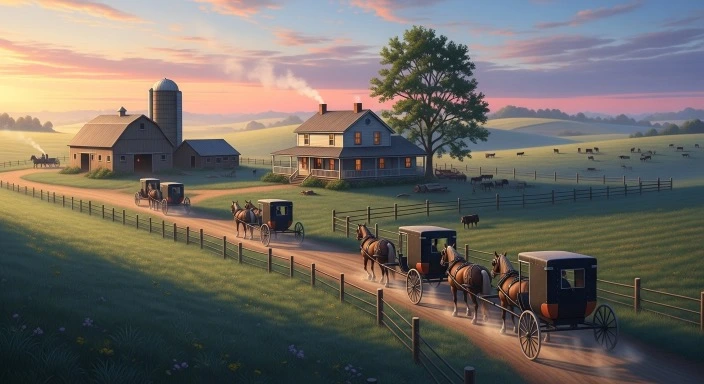
Imagine waking before sunrise, the scent of dew and fresh hay drifting across quiet farmland. The world feels still — not heavy stillness, but peaceful, like a hymn resting softly on morning air.
This is how an Amish wedding day begins.
There are no horns honking, no glowing screens, no rush to perfect makeup or scroll for attention. Instead, there is humility, work, prayer, and togetherness. A bride does not seek applause; a groom does not chase spectacle. Their union rests not on display but on faith, family, and community.
I once stepped into that world — not as someone seeking to document, but as someone hoping to understand. And what I found was not a ceremony, but a quiet celebration of devotion: to God, to simplicity, to one another.
This is not a story of extravagance.
It is a story of quiet beauty — the kind that lives deeper than glitter ever could.
Amish Women: The Heart of Faith, Family, and Simple Living
The Days Before — Preparing With Prayer and Purpose
In the Amish world, weddings are not events managed by planners or Pinterest boards. They are acts of community service and faithful preparation.
The bride and groom do not rest before the big day. Instead, they work harder than ever — cleaning, baking pies, preparing benches for guests, and helping family with farm tasks.
A wedding, you see, is not meant to serve the couple.
It is meant to serve everyone who attends.
The Bride’s Heartbeat
The Amish bride often sews her own dress — a simple, long-sleeved gown in soft blue, lavender, or other muted tones. It is not thrown away after the wedding; it becomes her Sunday church dress for years.
There are no diamonds.
There is no veil of lace and glitter.
Beauty rests not in sparkle, but in humility.
As PBS explains, Amish weddings emphasize faith, modesty, and community over display and luxury.
Where the Wedding Happens — Not a Church, but a Home
Amish weddings are held in homes or barns, transformed into worship spaces with rows of benches.
There is no aisle dripping with petals, no decorated arch, no altar framed by lights. A long table sits at the front for the minister and the couple.
The benches used are borrowed from other families — a literal sharing of seats and space, symbolic of their shared life ahead.
Everything reflects one truth: Faith makes a home holy — not decorations.
For similar themes of functional simplicity, read this article
Guests Arrive — Quiet Fellowship and Soft Footsteps
As buggies roll in, voices rise in warm greeting — slow, soft, respectful. Neighbors do not rush; they visit. Elders shake hands, women exchange gentle smiles, children stand shy but curious.
The atmosphere feels like a quilt:
stitched together by tradition, prayer, and community.
There are no printed invitations — only spoken ones.
No professional photographer — only memory.
No loud chatter — only heartfelt fellowship.
Here, presence matters more than presentation.
The Ceremony — Spoken Faith, Not Performed Love
When the service begins, there is no spotlight. The bride and groom sit with the congregation, not elevated but equal. The ministers preach about faith, commitment, selflessness, and harmony.
The Vows
Amish vows are not flourish and poetry.
They are plain words with deep weight.
Promises focus on:
- Obedience to God
- Support through hardship
- Building a life rooted in service and faith
There is no applause.
No dramatic kiss.
No rushing the moment.
Silence carries meaning.
Devotion speaks louder than emotion.
As Lancaster Online notes, Amish weddings are deeply spiritual events focusing on faith, community, and humility.
The Meal — Feasting Without Vanity
Amish wedding
Amish wedding
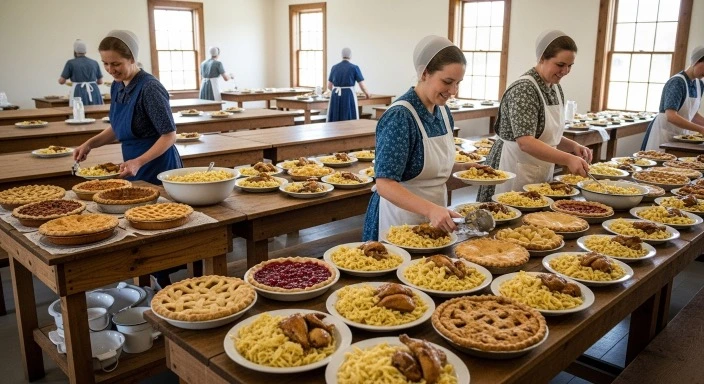
After the ceremony, comes a feast — not catered, but homemade. The menu may include:
- Roast chicken
- Mashed potatoes
- Homemade noodles
- Cooked apples
- Fresh rolls and butter
- Dozens of pies baked by young women in the community
No dish is plated for beauty — it is prepared for fellowship and nourishment.
Children pass dishes.
Sisters pour coffee.
Friends refill pitchers.
It feels not like serving guests, but feeding family.
Music, Conversation, and Pure Joy
There is no DJ booth.
No sound system.
No dance floor lit with choreographed color beams.
But there is music — soft hymns sung in harmony, voices layered like sunlight through leaves.
There is laughter — warm, modest, genuine.
And there is joy —
the kind not purchased or performed,
but rooted in gratitude.
Amish weddings are social blessings as much as spiritual ones. Young people mingle respectfully, elders talk of crops and family, and mothers quietly watch futures forming.
Gifts — Practical Love, Not Luxury
Gifts are given from the heart and hands — quilts, cookware, furniture, handmade tools, or baked goods. Each gift whispers:
“We believe in you. We want your life to flourish.”
There are no registries, no credit-card swipes, no pile of branded gift bags.
Only useful kindness and community support.
After the Wedding — Hospitality That Doesn’t End
Amish wedding
Amish wedding
After the feast, benches are rearranged into tables again for a late meal. Neighbors stay until dark, and friends may visit all week.
The couple does not rush to a honeymoon resort; often they remain in community, continuing to help and visit.
At its core, the wedding is not the end of a celebration —
it is the start of shared responsibility and faith.
Faith Over Fashion — Why Amish Weddings Feel So Pure
Every choice — dress, food, ceremony, gathering — points to one truth:
Marriage is a commitment before God, not a performance before people.
Where the modern world seeks personalization,
the Amish seek spiritual unity.
Where others chase beauty,
the Amish choose blessing.
Where others buy excitement,
the Amish cultivate contentment.
This simplicity is not limitation —
it is liberation.
Lessons We Can Carry With Us
You do not need a buggy or barn to learn from an Amish wedding.
You only need willingness to slow your heart.
Lessons to treasure:
- Love grows deeper in simplicity
- Joy can be humble and powerful
- Family and community are treasures
- Faith adds meaning where decor fades
- A wedding is a beginning, not an event
There is something profoundly refreshing here — a reminder that love doesn’t need grandeur to feel grand.
Final Thought — A Wedding You Don’t Watch, You Feel
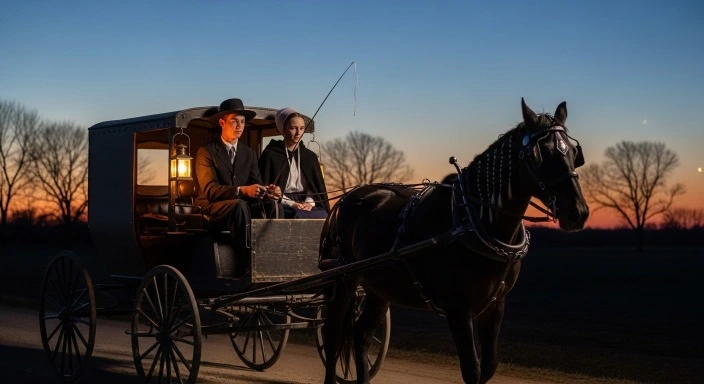
When I left that Amish farm, the sun was dipping low and lanterns glowed like quiet stars. The world felt softer — as if peace had settled over everything.
There had been no glitter, no speeches, no staged photos.
Only faith, food, family, and simple, beautiful joy.
In that sacred simplicity, I learned this:
Love doesn’t shine brightest when the lights are brightest.
It shines when hearts are pure,
hands are working together,
and joy comes from God, not glamour.
And that is a wedding worth remembering.