
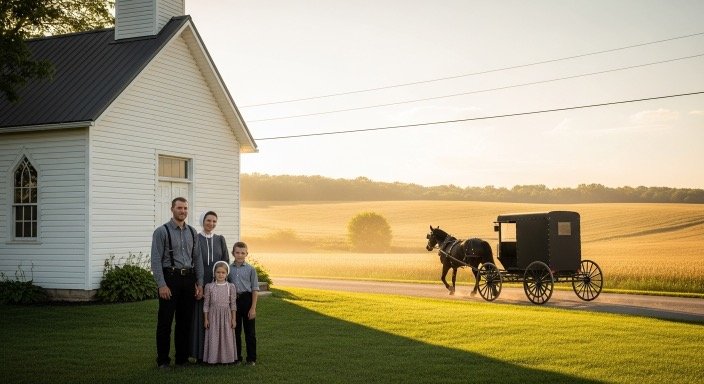
Mennonites vs Amish
In our fast-changing modern world, the idea of living simply, working with your hands, and gathering in community can seem either nostalgic or radical. Yet today you’ll find two faith traditions thriving precisely because they embrace simplicity and community: the Mennonites and the Amish. At first glance, they look similar: plain dress, faith rooted in the Anabaptist movement, strong sense of community. But pause a moment and you’ll see distinct lives shaped by shared values yet diverging paths.
This article invites you into the journey of Mennonites vs Amish — how both emerged from the same spiritual soil, how they chose different branches, and how faith keeps each tradition alive in the present moment. We’ll compare their beliefs, dress, technology, worship and work lifestyles side by side, explore their history, and draw out meaningful lessons for all of us seeking rootedness in a busy world.
1. Historical Background: One Root, Two Branches
The story begins in the mid-16th century with the Anabaptist movement, a radical wing of the Protestant Reformation that rejected infant baptism, embraced adult confession of faith, and insisted on a church separate from state control.
† Menno Simons (1496–1561) emerged in the Netherlands as a central leader of the early Anabaptists. He urged non-violence, believer’s baptism and a life of discipleship: “Men who are guilty of sin should not be under the sword of secular punishment but under the ban of the church,” he wrote — emphasizing church discipline and faith in action.
† In the late 1600s, tensions grew within Swiss Anabaptist communities over how strictly one should live apart from the world. A key figure was Jakob Ammann, who argued for stricter shunning, dress, and adherence to tradition. He led a split in 1693 which created the Amish branch. (PBS)
From that split onward, we see two siblings of faith: the Mennonites anchored in broader engagement and the Amish choosing stricter separation. Both continued growing — especially in North America from the 18th century onward. Today both traditions persist and flourish, each preserving faith in their own way.
2. Core Beliefs: Shared Foundations, Distinct Emphases
Both Mennonites and Amish uphold key Anabaptist convictions: adult baptism, nonresistance, community discipline, and a Christ-centered life. Yet in practical emphasis and communal application, differences show.
Table 1: Beliefs Comparison – Mennonites vs Amish
| Belief Area | Mennonites | Amish |
| Adult Baptism & Confession | Emphasized, often in a formal church setting | Emphasized, in home or meeting service with strict expectations |
| Nonresistance & Pacifism | Strong tradition of peace-making, missionary work | Deeply rooted nonresistance, focus on community avoidance of state & military |
| Engagement with Society | Many groups engage in social work, humanitarian missions | Greater separation from what is considered “worldly” involvement |
| Church Discipline & Shunning | Varies widely, less strict in many modern groups | More formal practice of shunning/excommunication in some Old-Order groups |
| Simplicity & Humility | Value simplicity, but variable in practice | Simplicity and humility are central, visible markers of faith |
These differences shape not just theology but everyday life. For instance, the Amish are more likely to restrict technologies, changes in dress, and societal engagement, believing that such restraints protect communal faith. Mennonites, while also valuing simplicity, often allow greater flexibility and broader engagement. In the words of Mennonite historian Donald Kraybill: “The Amish may say, ‘We must not imitate the world,’ while many Mennonites say, ‘We must engage the world.’”
3. Dress and Modesty: Plainness with Purpose
Mennonites vs Amish
Mennonites vs Amish
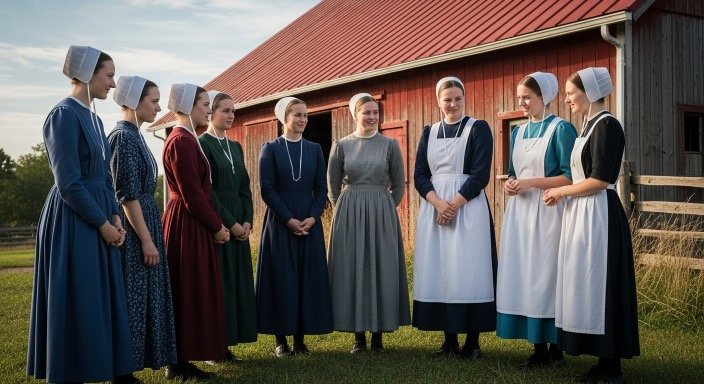
Dress is one of the most visible markers of difference — and yet it speaks of similar values: modesty, simplicity, community.
Table 2: Dress & Appearance – Mennonites vs Amish
| Aspect | Mennonites | Amish |
| Women’s Dress | Conservative styles, often plain dresses; more variation in colours in moderate groups | Very plain dresses; solid colours; aprons; bonnet (kapp) for married women |
| Men’s Dress | Plain shirts and trousers, sometimes plain coats; hats vary by group | Suspenders, broad-brim hats, dark trousers and coats, beard after marriage |
| Technology / Fabrics | More use of modern fabrics, patterns depending on order | Handmade clothing often, traditional fabrics, limited patterns |
| Vehicles & Mobility | Many drive cars in moderate groups | Horse & buggy typical in most Old-Order settlements |
For the Amish, dress is an outward reflection of inward humility — a visible sign of community belonging and faith. The bonnet (kapp) worn by women symbolizes submission to God’s order, while the plain men’s attire signifies equality and simplicity.
Even in dress, the two groups show distinct rhythms: Mennonites may show more internal variation and moderate adoption of modern styles, while the Amish hold tightly to uniformity in dress as a spiritual discipline.
Read our other article about Amish women’s clothing
4. Technology & Modern Life: Choices that Preserve Community
Mennonites vs Amish
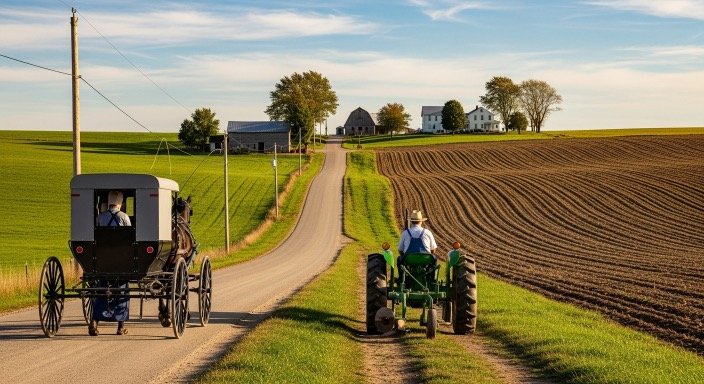
How one uses technology can reflect a faith posture. The Amish and Mennonites each evaluate technology differently — not merely by what’s available, but by how it affects relationships, faith and community.
Table 3: Technology & Modern Life – Mennonites vs Amish
| Technology Area | Mennonites | Amish |
| Automobiles | Common in many Mennonite congregations | Mostly horse–and–buggy transportation; some allow cars for business or taxis |
| Electricity / Telephones | Many use electricity and phones; some conservative groups limit usage | Widespread avoidance of grid electricity and personal phones; community phones may exist |
| Internet / TV | Some permit TV/Internet, others restrict | Very limited or no personal internet/TV; emphasis on face-to-face community |
| Farming Equipment | Use tractors, modern machinery in many groups | Often horse-powered or minimal machinery in Old-Order settlements; decisions based on communal rules |
The Amish ask: “Does this technology draw us together, or pull us apart?” (As noted in a profile of how Amish evaluate phones, vehicles and machines.) (WIRED) Meanwhile many Mennonite groups see technology as a tool for service — mission work, sustainable agriculture, communication. Yet both traditions use technology intentionally, not by default.
5. Worship & Community Life
Worship and communal rhythms reflect each tradition’s sense of faith in action. The Amish often gather in homes every two weeks, rotating church services among families. Their worship may be in German or Pennsylvania Dutch, last several hours and emphasize devotion, humility, and separation from the world.
Mennonites usually meet weekly in dedicated church buildings, with more variation: contemporary music, English services, active mission outreach. Their community life tends to flow outward as well as inward.
What binds both is a deep sense of community — neighbors helping neighbors, shared meals, and mutual care. In this sense, faith is lived, not just declared.
6. Family & Education: Passing Values Across Generations
Family is central in both Mennonite and Amish traditions. Fathers and mothers work together, children are raised with responsibility, and schooling often ends by the eighth grade in Old-Order communities, focusing thereafter on practical living skills. (Amish Country Lodging)
In Amish households, children help in the fields, learn by observation, and participate in family rhythm. Many Mennonite families also follow this, though some allow higher education, professional careers, and broader societal engagement.
Education is not just academic—it’s vocational and moral: teaching children how to work, pray, serve and live simply.
7. Work & Simplicity: Purpose Over Possession
In both traditions, work is sacred. Whether tiling a field or crafting fine furniture, Amish and Mennonite men and women believe labor reflects divine creativity. The Amish often focus on agriculture and craftsmanship; Mennonites may engage in business, sustainable farming and global service.
Yet the benchmark is not income, but integrity: Does this work serve the community? Does it honor God? That question guides both traditions. The difference lies in how widely they apply it in the world.
8. Modern Adaptations: Living Faith in Today’s World
Though rooted in tradition, both groups adapt — cautiously, intentionally, and communally. Mennonites may run development agencies or engage in volunteer service around the world. Amish settlements may adopt propane refrigerators or compressed-air tools, but always with communal oversight.
These adaptations tell us: faith doesn’t freeze time—it changes how time is lived. Whether one chooses slow or more engaged living, the underlying commitment is the same: live out the Gospel in community.
Key Takeaways
- Both Amish and Mennonite traditions stem from the 16th-century Anabaptist movement and share foundational beliefs even as they diverged.
- Visible differences (dress, technology, worship style) reflect deeper choices about community, separation and service.
- Each tradition offers a distinct model for modern life: one of separation, one of engagement — yet both rooted in faith, simplicity and mutual care.
- Their example reminds us that how we live matters — faith isn’t just what we say, it’s how we dress, work and gather.
Final Thoughts: Two Paths, One Light
In comparing Mennonites and Amish, you may see different modes of living, different speeds of adaptation, different degrees of separation. But beneath those differences lies a shared heart: faith in community, humility before God, and work done with hands and purpose.
In a world overwhelmed by speed, choice and noise, they invite a slower rhythm: one where neighbors care for one another, work is meaningful, and faith isn’t hidden—it’s lived.
As you reflect on their stories, may you find inspiration — perhaps not to replicate their lives exactly, but to ask: What rhythms of simplicity, community and faith could shape my life today?